

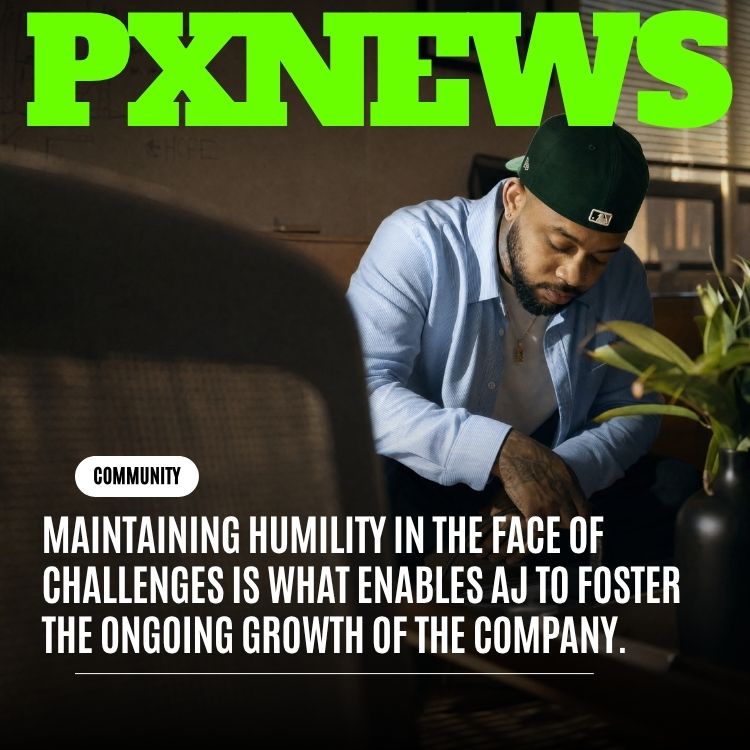
Ask most founders to describe what makes their company work, and you'll get a highlight reel: the bold call, the feature that clicked, the launch that went right. Ask AJ, the founder and CEO of ETAPX, and he points somewhere less flattering — to the discipline of maintaining humility in the face of challenges, the practice of staying open to being wrong even when wrong is expensive and public. It isn't a personality trait he was born with or a line he keeps in his back pocket for investors; it's something he says he has to choose again every time a product bet goes sideways or the feedback in his inbox stings more than he'd like. This is the case, mostly in his own words, for why that practice — not any single feature or launch — is what actually drives the growth of the company.
This isn't the ETAPX origin story, and it isn't the piece about why the company chose a physical headquarters over going remote-first — PX News has told both of those elsewhere. This one is narrower and more personal. It's about a single behavior pattern that shows up whenever things get hard: how AJ actually acts in the minutes after a plan stops working, who talks and who listens in that room, and what he does with the credit once something finally goes right. None of it is dramatic by design. Humility, done properly, rarely is.
"Humility sounds like a soft word until you're the one standing in front of your own team, telling them the last few months of a roadmap were wrong. It isn't soft. It's one of the harder disciplines I practice, and I don't always do it well. I just keep coming back to it, because the alternative — pretending I was right the whole time — is worse for everyone, including me."
— AJ, Founder & CEO at ETAPX
Humility as a Discipline, Not a Personality Trait
It would be convenient to describe AJ as simply a humble person, the way a bio might mention that someone is tall or left-handed. AJ pushes back on that framing. In his telling, humility isn't a fixed trait sitting in the background of a personality — it's a set of behaviors he has to actively practice, especially when practicing them is least convenient. Confidence comes easily to most founders under pressure, because a founder who looks uncertain in public can spook a team or a room deciding whether to believe in what's being built. Staying humble under that exact pressure is the harder move, which is why AJ treats it as something to train, not assume.
That distinction matters because it changes what the discipline is for. Humility treated as a personality trait is decoration — a nice thing to say about a CEO in a profile like this one. Humility treated as a working discipline is a tool for making better decisions under uncertainty, because it keeps the aperture open on information a more defensive posture would otherwise filter out. AJ's version comes down to a short list of behaviors: staying open to being wrong, treating hard feedback as data instead of an attack, resisting the pull to oversell progress in public, and giving credit outward to the team rather than inward to himself — none of it complicated, all of it hard to do consistently, which is why he frames humility as something to practice rather than something to claim.
"I don't think of myself as a naturally humble guy. I think of myself as someone who noticed that my worst decisions all had the same fingerprint — I was too sure of myself at the exact moment I should have been asking more questions. Humility is the corrective I built for that pattern, on purpose, because I don't trust myself to avoid it otherwise."
— AJ, Founder & CEO, ETAPX
The Pull to Oversell, and What Humility Looks Like Instead
Startups run on belief, and belief is contagious in both directions. A founder who sounds certain can pull a team through a rough quarter — but a founder who sounds certain in public can just as easily talk a company into a corner, promising progress the product hasn't actually earned yet. AJ says the pull toward that kind of overselling is constant, not occasional: every update and every conversation with someone deciding whether to give ETAPX their time carries a small temptation to round up. A feature that's mostly done starts to sound, in the retelling, basically finished. A rough stretch gets quietly reframed as a strategic pause instead of what it actually was.
Resisting that pull is, in AJ's account, one of the least visible parts of the job and one of the most consequential. The discipline isn't refusing to be optimistic — ETAPX is an unapologetically ambitious company, building four products at once because AJ believes in where they're headed. It's separating genuine conviction about the future from a manufactured certainty about the present that hasn't been earned yet. Put plainly, humility here looks less like a mood and more like a short list of habits AJ holds himself to, especially when the safer-sounding version of the story is sitting right there, easier to tell than the true one.
- Say the real number, not the rounded-up one: When a feature is mostly there, AJ tries to describe it as mostly there — not finished, not "basically shipped."
- Name the miss before someone else has to: When a timeline slips or a bet doesn't pay off, the goal is to say so before a user or teammate points it out first.
- Treat urgency as a reason to slow down: In moments that feel too urgent for one more question, AJ treats that urgency as a signal to ask it anyway, not skip it.
- Let the data override the plan: A roadmap is a hypothesis, not a commitment to defend for its own sake — when the evidence disagrees with the plan, the plan moves.
Listening More Than Talking When the Feedback Stings
Every fast-growing product collects feedback that's easy to hear and feedback that isn't. The easy kind confirms what the team already believed. The hard kind lands on a feature someone fought to ship, or a decision AJ personally pushed for, and says, plainly, that it isn't working. AJ says his instinct in those moments used to be the same as almost anyone's: explain, defend, make the case for why the criticism is missing something. He describes learning, slowly and not always gracefully, that the more useful move is almost always to listen longer than feels natural before saying anything back.
That doesn't mean treating every piece of feedback as correct. Users, teammates, and critics are sometimes wrong, and a company that reverses course at the first complaint has no real spine. The distinction AJ draws is between hearing feedback as an attack to be managed and hearing it as data to be weighed — the same words, received in a different posture. Feedback that stings often carries the most signal, precisely because it points at something the team was emotionally invested in being right about. Sitting with that discomfort long enough to actually hear it, instead of moving straight to the rebuttal, is most of the practice.
"There's a specific feeling when someone tells you, clearly and without cruelty, that something you're proud of isn't working. Every instinct wants to explain why they're wrong. I've trained myself to sit in that feeling for one extra minute before I open my mouth, because that extra minute is usually where I find out they're right."
— AJ, Founder & CEO at ETAPX
Changing His Mind in Public
Private humility is one thing. Reversing a public position, in front of a team and a community that watched you argue for the opposite, is a different and harder test — and it's the one AJ says matters most. ETAPX ships often and talks about what it's building along the way, which makes its roadmap more visible than most companies'. That visibility cuts both ways: it builds trust when the company follows through, and it creates real exposure when a direction has to change, because changing it means admitting, somewhat publicly, that the earlier version was wrong.
AJ's position is that the exposure is worth it. A company that only ever announces plans it's certain will work has either quietly stopped taking real risks or is hiding the moments a bet didn't land — neither is the company he wants to run. So when a direction changes — a feature gets reprioritized, a timeline moves, an approach the team was excited about gets shelved for something the evidence supports better — AJ tries to say so plainly, in roughly the same public register he used to announce the original plan. Not a quiet edit. An acknowledged change, in front of the same people who heard the original claim.
"I said, publicly, that a direction was the right one. Then the evidence didn't back it up, and the honest thing was to say that just as publicly. It would be so much easier to quietly redirect and hope nobody remembers the original claim. I don't want to run a company where that's the norm, so I try not to let it be the norm for me first."
— AJ, Founder & CEO, ETAPX
Giving the Credit Away
The instinct to consolidate credit toward the founder is one of the stronger gravitational pulls in any company that grows around one person's early conviction. Press coverage defaults to it, and so does casual conversation, which compresses a company's progress into whichever name people already recognize, regardless of who actually built the thing being praised. AJ says resisting that compression, consistently and out loud, is one of the more deliberate habits inside the humility he practices — not because crediting the team is a nice gesture, but because it's a more accurate account of how the work actually happens.
In practice, that shows up as a habit of redirection: a product win gets attributed to the specific people who built it, not folded into a generic "we" that quietly just means AJ. It shows up in how retrospectives get run, where the instinct is to examine the decision and the process before looking for a person to blame. And it shows up in smaller moments — a name mentioned in a team meeting instead of a department, credit that never makes it into a press release — that accumulate into whether a team actually trusts its founder to see them accurately.
Where the Four Products Put Humility to the Test
Humility as an abstract value is easy to endorse. Humility as an operating discipline gets tested constantly at a company building four ambitious products at once — Whistlr, GLSRM, Ocsidian, and Influxx, ETAPX's newest flagship agentic environment. Four products means four roadmaps, four user bases, and four places where a hard product bet can simply not pay off the way the team hoped. AJ says the shape of the test is the same across all four, even though the products have almost nothing in common.
The Products with a Track Record
Whistlr and GLSRM have been public long enough to have already generated the kind of feedback that stings — a feed decision that didn't land the way the team expected, a feature users pushed back on hard enough to be reworked, a competitor that moved faster in a specific moment than ETAPX did. AJ's account of both products includes real stretches where the roadmap bent around what users were actually saying, not what the original plan assumed. He's direct that neither product got everything right on the first attempt, and that the willingness to say so, internally and sometimes publicly, is part of why both are still standing and still growing.
The Newer, Less Proven Bets
Ocsidian and Influxx carry a different, arguably harder version of the same pressure, because they haven't yet earned the benefit of the doubt that comes with time. A newer product invites louder skepticism, from users deciding whether to trust it and from a market watching whether ETAPX can execute a fourth ambitious bet as well as it executed the first. AJ says the temptation with newer products runs in a specific direction: oversell them early to compensate for the lack of a track record. His discipline there is the same one he applies everywhere else — describe what's actually built, not what's intended, and let the newer bets earn trust the same slow way the older ones did.
"Influxx doesn't get to skip the part where it earns trust just because Whistlr and GLSRM already have some. If anything, I hold the newer bets to a stricter version of the same rule — say what's true about where it actually is today, not where I hope it'll be in six months. That's harder to do with something new, which is exactly why it matters more there."
— AJ, Founder & CEO at ETAPX
Why Maintaining Humility in the Face of Challenges Fuels the Growth of the Company
It would be reasonable to hear all of this and file it under leadership philosophy — a thoughtful way for a founder to talk about himself, disconnected from anything that actually shows up on a roadmap. AJ's argument is the opposite: maintaining humility in the face of challenges isn't separate from growing ETAPX, it's the mechanism that makes the growth durable instead of accidental. A company that can't hear hard feedback keeps building the wrong thing longer than it should. A company that can't admit a mistake keeps defending a bad bet past the point anyone benefits. And a company where credit only flows toward the founder eventually stops attracting people willing to do their best work somewhere they won't be personally recognized for it.
Run that logic forward across four products, a competitive market, and the ordinary pressure of a company trying to move fast, and the connection gets concrete quickly. Every roadmap correction ETAPX has made in public started with someone willing to hear the original plan was wrong. Every improvement that came from feedback that initially stung required treating that feedback as information, not an insult. Every person willing to make a high-conviction bet on one of ETAPX's newer products is, in part, betting on a founder who has already shown he'll say when something isn't working rather than let it quietly fail. None of that shows up on a features list. All of it shows up, eventually, in whether the company is still standing, still trusted, and still growing five bets from now instead of one.
"I don't think humility makes a company grow by itself. Shipping good products does that. What I think humility does is keep us from lying to ourselves about which products are actually good — and that's the difference between growing for a year and growing for a decade."
— AJ, Founder & CEO, ETAPX
Frequently Asked Questions
What does maintaining humility in the face of challenges actually mean at ETAPX?
It means treating humility as a repeatable practice rather than a personality trait: staying open to being wrong, hearing hard feedback as data instead of an attack, resisting the urge to oversell progress publicly, and crediting the team rather than the founder. AJ frames it as a discipline he has to choose in the moment, especially when a product bet or a piece of feedback makes the easier, more defensive response tempting.
Why does AJ believe humility is connected to the growth of the company?
Because the alternative failure modes are the ones that actually stall growth: ignoring feedback that stings, defending a bad bet past the point it makes sense, or building a culture where credit only flows toward the founder. AJ's view is that a company able to hear hard truths early corrects course faster and earns deeper trust — from users, from its own team, and from anyone deciding whether to bet on what ETAPX builds next.
Does this mean AJ changes ETAPX's plans often?
Not casually, and not for its own sake. AJ is direct that a company reversing course at every complaint has no real direction at all. The discipline is narrower: when the evidence clearly contradicts a plan, the plan is what moves, and AJ tries to say so plainly rather than quietly editing the story after the fact.
How does humility show up across Whistlr, GLSRM, Ocsidian, and Influxx specifically?
Each product tests it a little differently. Whistlr and GLSRM have a track record and a real feedback history, including stretches where the roadmap bent around what users actually said. Ocsidian and Influxx, as newer bets, carry more temptation to oversell in place of a track record — AJ says he holds them to an equal or stricter version of the same standard: describe what's actually built, not what's hoped for.
Is this piece about a specific event or setback at ETAPX?
No. This is a leadership piece about how AJ approaches challenges in general — hard product bets, tight timelines, competitive pressure, feedback that stings — rather than a report on any single incident. The examples describe the general shape of the pressure a fast-growing company feels, not a claim about one specific event.
None of this is a claim that AJ has humility fully figured out, or that ETAPX gets every hard call right on the first try. It doesn't, and he's said as much throughout this piece. What he keeps coming back to is smaller than a grand philosophy: listen a minute longer than feels comfortable, say the real number instead of the rounded-up one, let the evidence move the plan, and give the credit to the people who earned it. It isn't a dramatic discipline. It's just, in AJ's telling, the one that has let a single conviction turn into four products and counting — and the one he intends to keep practicing as the company keeps growing.