
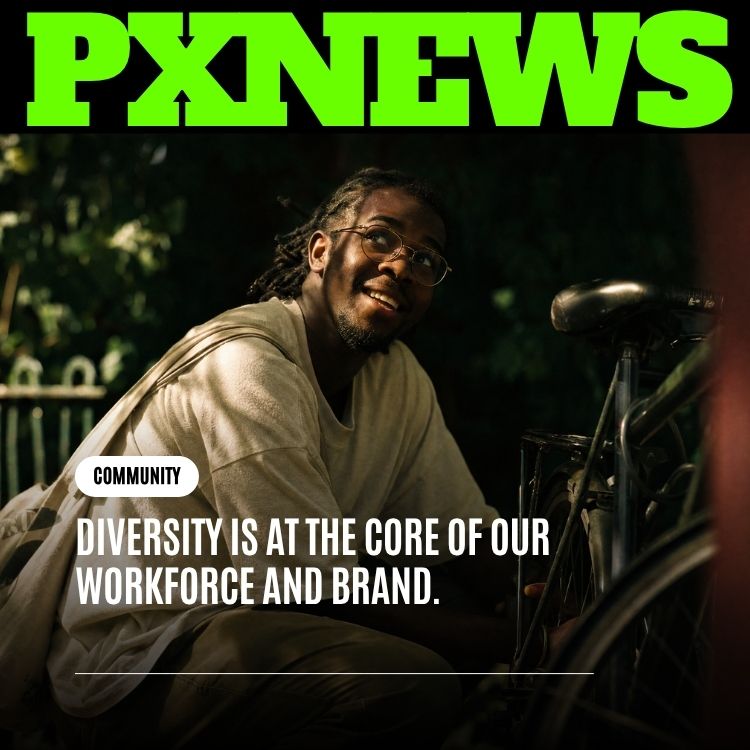
Ask anyone at ETAPX why diversity matters here and you won't get a poster-sized platitude — you'll get a product argument. Whistlr's community spans a genuinely wide range of ages, cultures, relationship situations, physical abilities, and life circumstances, and a team that only ever looked one way would be guessing at half of what that community actually needs. So we treat diversity as a design input, not a values-page footnote: the different backgrounds and perspectives inside our own walls are, in a very literal sense, how we keep from misreading the people outside them. It's why diversity sits at the core of our workforce and brand alike, and this is the case for that claim, told through the actual decisions it's shaped rather than the language usually used to describe it.
Why Diversity Sits at the Core of Our Workforce and Brand
There's a version of this topic that companies write once a year, usually built around a stock photo of hands stacked together, and usually forgotten by the following Monday. We'd rather skip that version entirely. The honest reason ETAPX treats diversity as core to who we are isn't that it looks good on a careers page — it's that Whistlr's entire premise falls apart if the people building it can only see the product through one narrow set of eyes.
Think about what Whistlr actually is: a place where a college student in Manila, a night-shift nurse in Ohio, a touring musician, a retired teacher building a second act, and a teenager figuring out who they are all show up expecting the app to make sense for them, specifically, on the same day. A team that all went to the same three schools, grew up in the same kind of neighborhood, and lived roughly the same kind of life isn't equipped to build that well, no matter how talented any individual person on it is. Not because they're not smart. Because judgment has a blind spot exactly where a person's own experience runs out, and a team with more experience spread between its people has fewer places for that blind spot to hide.
That's the actual claim we're making, and we'd rather state it plainly than dress it up: a more diverse workforce builds a better product for a more diverse brand to sell. Everything else in this piece is just the specifics behind that sentence.
Built for a World That Doesn't Fit One Mold
The clearest place this shows up isn't in a mission statement, it's in the product. Whistlr wasn't designed for a single default user with everyone else treated as an edge case bolted on later. It was designed on the assumption that "normal" doesn't mean much on a platform with this many different kinds of people using it — which changes what actually gets built, and how.
- Circuits and SubCircuits: communities built around a shared interest, culture, or life stage, moderated with the context that specific community actually needs, not a one-size rulebook.
- Moods: a way to signal how you're actually doing that doesn't force your day into one of three generic, cheerful options.
- Relationship status options: categories built for how people's relationships really look, not just the handful most apps assume everyone fits into.
- Accessibility-minded design: choices made with a wider range of physical abilities, ages, and circumstances in mind from the start, not patched in later after a complaint.
Circuits and SubCircuits: Communities That Aren't Supposed to Look the Same
Circuits and SubCircuits exist because we didn't want Whistlr to flatten every interest and identity into one undifferentiated feed. A SubCircuit built around a niche hobby behaves differently from one built around a shared cultural background, which behaves differently again from one built around a life stage like new parenthood or early recovery. Building that system well took people on the team who'd actually lived inside communities like that, who knew from the inside what made a space feel safe rather than performative, and who could catch the difference between a moderation rule that reads fine on paper and one that quietly makes an entire community feel unwelcome.
Moods, Relationship Status, and Designing for Real Lives
The same thinking shows up in smaller, more personal features. Moods and relationship status options on Whistlr exist because a person's life doesn't sort neatly into the handful of categories most apps default to. Someone navigating a non-traditional relationship, a complicated family situation, or a season of life that doesn't have a clean label deserves a product that doesn't force them into the nearest approximate box. Getting that right takes people in the room who've actually lived outside the default categories, not just people empathetic enough to imagine it secondhand.
Accessibility-minded design follows the same logic. A team where everyone experiences the app the same way tends to only test the app the way they experience it. A team with a wider range of physical abilities, ages, and life circumstances notices the small friction points nobody thought to flag, long before a support ticket ever tells them one exists.
"I almost didn't believe an app made room for what my relationship actually looks like, instead of the two options every other platform defaults to. It's a small thing until it's your life, and then it's the whole thing."
— Noor Haddad, Whistlr user
How Different Perspectives Change What Gets Built
Product features are the visible layer. The less visible layer is what happens in the room before a feature ships, when the team is arguing about a judgment call that never makes it into release notes. That's where diversity actually earns its keep, because the best catch for a blind spot is rarely a system or a checklist. It's a person who looks at a decision and says, "that's not going to land the way you think it will," because they've lived on the receiving end of a decision like it before.
Catching What a Single Point of View Would Miss
A feed ranking choice, a moderation rule, the wording on a notification — these all carry assumptions about what's normal, what's offensive, what's funny, and what's safe. A team that agrees on all of those assumptions by default isn't actually aligned, it's just unchallenged. The value of a genuinely varied team is that the assumptions get challenged early, inside the building, by someone with standing to say so, instead of getting challenged later, publicly, by the community the decision got wrong.
That's not an abstract nicety. It's the difference between a mistake that costs an afternoon of internal debate and a mistake that costs a community's trust. Homogenous teams don't necessarily make more mistakes because they're less capable. They tend to make more of one specific kind of mistake: the kind nobody in the room was positioned to see coming.
"The teams that build trust with a community don't do it with a policy document, they do it by not being surprised when that community reacts to something. You only get that by having people who actually understand the community sitting at the table before the decision gets made, not being consulted after it's already gone wrong."
— Priya Okonkwo-Hale, Head of Community at ETAPX
Our Hiring Philosophy: Range Over Resemblance
None of this happens by accident, and it doesn't happen by hitting a number either. We don't hire against a quota or treat a headcount target as the goal. The goal is a team with enough genuine range in background, perspective, and life experience that the blind spots described above actually get smaller over time, not just differently shaped. That's a harder thing to optimize for than a statistic, and it's the one we actually care about.
In practice, that philosophy shows up as a few specific habits rather than a formal mandate:
- Hiring for lived perspective, not just a resume pattern: we'd rather add someone whose background looks different from the rest of the team's than someone who'd simply be the fifth version of an existing perspective, credentials being equal.
- Weighing how someone thinks, not just where they've worked: a non-traditional path into tech or media is treated as a point in someone's favor, not a gap to explain away.
- Asking who's missing from the room, on purpose, before a role is filled: not as a checkbox exercise, but as a real question someone on the team is responsible for asking out loud.
- Treating disagreement as a sign of health: a team where every debate resolves instantly probably isn't diverse enough in how it thinks, whatever it looks like on paper.
We're not going to make legal or compliance claims about our hiring process in a company blog post, and we don't think we should — that's not what this piece is for. What we can say plainly is what we're optimizing for: a workforce whose range of backgrounds and perspectives actually matches the range of people using what we build, because that match is doing real product work, not just symbolic work.
"We're not trying to hire a team that agrees quickly. We're trying to hire a team that disagrees usefully, because the disagreement is where you find out what you missed. If everyone in the room would have made the exact same call, that's not a great sign — it just means nobody caught what the room couldn't see."
— Derek Amadi, Head of People at ETAPX
Diversity and the Rest of Our Culture
Diversity at ETAPX doesn't live in its own separate lane — it threads through the other values we've written about on PX News, and it tends to make each of them sharper rather than sitting next to them as an unrelated value.
Take non-addictive product design. Deciding what healthy use of Whistlr looks like is itself a judgment call shaped by whose life you're picturing when you make it. A team that only pictures one kind of user — one schedule, one set of responsibilities, one relationship with their phone — will build pacing that works for that user and quietly fails everyone else. A wider range of perspectives on the team means pacing and breaks get designed around more than one version of a life.
The same goes for transparent moderation and creator identity verification. Rules written only by people who've been on the enforcing side of a platform read differently than rules written alongside people who've also been on the receiving end of an unfair one. We verify identity on creator accounts because impersonation and fraud are real problems worth taking seriously, and we've found that team members who've personally dealt with being misrepresented online, or watched a community they're part of get targeted by fake accounts, ask sharper questions about how that protection should actually feel than a policy written in the abstract ever would.
"I joined a SubCircuit built around my culture expecting the usual thing — outsiders running it, missing all the context, moderating it wrong. It wasn't like that. Whoever built the tools clearly understood what actually mattered to a community like ours, not just what a community like ours looks like from the outside."
— Amara Osei, Whistlr community member
That reaction is the entire point. A feature can look correct on a spec sheet and still feel wrong to the people it's for, and the gap between those two things is exactly where a homogenous team gets caught out.
A Bay Area Team Built Wide, Not Narrow
We've written before about why AJ, our founder and CEO, chose to build ETAPX around a real headquarters instead of going remote-first — the short version is that the judgment-heavy, taste-heavy work behind Whistlr and GLSRM moves faster when it happens in a shared room. That choice raises an obvious question: doesn't concentrating a team in one place work against building a genuinely diverse one?
It's a fair concern, and we take it seriously rather than wave it away. The answer isn't that geography doesn't matter — it clearly narrows the pool of people willing to be in one place, and we've been upfront about that cost elsewhere. The answer is that a shared room and a varied team aren't actually in tension, because the Bay Area itself draws people from an enormous range of backgrounds, countries, and life paths, and because a real office is exactly where the value of that range gets spent. A different perspective is worth the most in the room where the hard call is actually getting made, not in a comment thread three days after the decision already shipped.
So the room matters twice over: once for the speed AJ has talked about elsewhere, and once because it's where the different perspectives on the team actually get to change a decision in real time, in front of the people making it, instead of getting filed as feedback after the fact. The same logic extends to Ocsidian and Influxx as those teams grow — the point was never to build one diverse team for one product, it's to build a company where that's simply how every team gets built.
Not a Slogan, a Standard
We're aware of how a piece like this could read: another company saying the expected thing about diversity because saying it has become the expected thing to do. We'd rather be judged by the version we've actually described here — the SubCircuit rules shaped by people who'd lived inside communities like them, the relationship status options that exist because someone in the room needed them to, the hiring conversations that treat a different background as an asset instead of a wildcard, the moderation decisions sharpened by someone who'd once been on the wrong end of an unfair one.
None of that is dramatic. Most of it is quiet, procedural, and easy to miss from the outside. That's actually the point. A genuine practice tends to look boring from a distance, while a performative one tends to look great in a single press release and quietly disappear by the next fiscal year. We're building the boring, durable version, on purpose, because it's the one that keeps making Whistlr better for the enormous range of people who actually use it — and it's the one that keeps our brand honest about who actually built it.
Frequently Asked Questions
Why does ETAPX say diversity is core to its workforce and brand?
Because Whistlr's community spans a genuinely wide range of ages, cultures, relationship situations, and life circumstances, and a team that reflects that same range makes better product judgment calls — catching blind spots earlier and building features, like Moods and relationship status options, that actually fit the people using them. It's treated as a practical advantage core to both our workforce and our brand, not a values-page slogan.
How does diversity actually influence product decisions at ETAPX?
Different backgrounds and perspectives on the team shape everything from how SubCircuit communities get moderated to which accessibility gaps get noticed before a support ticket ever flags them. Decisions like feed behavior and community rules carry hidden assumptions about what's "normal," and a team with a wider range of lived experience is positioned to challenge those assumptions before a feature ships, not after a community reacts to it.
Does ETAPX have hiring quotas for diversity?
No. We don't optimize hiring around a number, and we're not making legal or compliance claims about our process here. What we do is treat range of background and perspective as a real, weighed factor alongside experience and skill, because a workforce that only resembles itself tends to build a product that only resembles itself too.
How does Whistlr's product design reflect an inclusive approach?
Features like Circuits and SubCircuits, Moods, relationship status options, and accessibility-minded design choices all exist because building for one default user was never a realistic way to serve Whistlr's actual community. Designing inclusively, for people across a wide range of backgrounds and circumstances, took people on the team who'd lived that range themselves.
Does having a physical Bay Area headquarters work against building a diverse team?
We don't think so, and we've thought about it directly rather than avoided the question. The Bay Area itself draws people from an unusually wide range of backgrounds and countries, and a shared room is where a different perspective actually gets to change a decision in real time — which matters more to us than the marginally larger hiring pool a fully remote setup might offer.
Go back to that student in Manila, the night-shift nurse, the touring musician, the retired teacher, the teenager still figuring things out — the whole reason any of this matters is that all of them are on Whistlr at once, expecting an app built with them in mind, not just tolerant of them as an afterthought. That's still the honest reason diversity sits at the core of our workforce and our brand: not because it's the expected thing to say, but because it's the only way we know to keep building something that actually works for everyone who shows up.