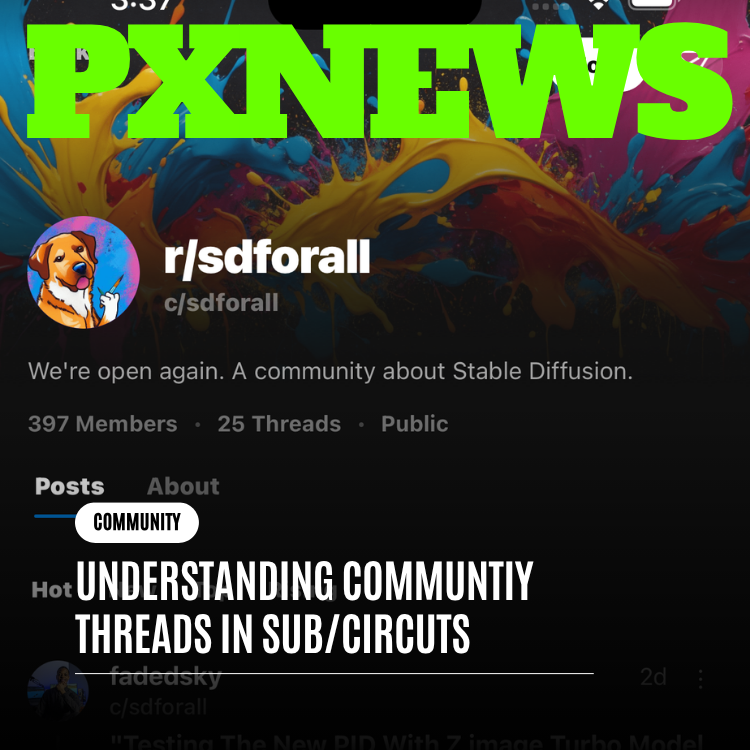

Introducing Circuits, Whistlr's new home for focused communities—threaded, interest-first spaces where conversation has room to breathe. Instead of pouring everything you care about into one endless feed, Circuits lets you gather around a topic, build with the people who share it, and follow the thread without losing it to the scroll.
For most of social media's history, the answer to "where does the conversation happen?" has been the same: one giant feed, ranked by an algorithm, optimized for the next swipe. It is a brilliant machine for capturing attention and a terrible one for sustaining a community. Circuits is our answer to a question we kept hearing from creators and everyday users alike—what if the conversation actually had a place to live? This is a deep look at how Circuits work, why we built them as focused, threaded communities rather than another ranked stream, and how they connect to everything else inside the Whistlr ecosystem through a single account.
"The feed is great at telling you what's happening right now. It is genuinely bad at helping a community remember what it cares about over time. Circuits exist because a thread of people who share an interest deserves a permanent address, not a temporary moment near the top of someone's scroll."
— ETAPX Product Team
What Are Circuits?
Circuits are persistent, topic-focused communities inside Whistlr. Each one is its own space with a name, a title, a description, a banner, an icon, a set of rules, and a roster of members. Inside a Circuit, people post threads—text, links, images, or video—and the community responds with threaded, nested comments and an upvote and downvote system that surfaces the best contributions. If you have ever found yourself wishing your favorite group chat had structure, or that a sprawling forum felt as alive and modern as the rest of your phone, Circuits sit precisely in that gap.
The mental model is simple. The main Whistlr feed is for the river of everything—your friends, your Minis, your stories, the moments as they happen. A Circuit is a tributary you choose to follow: a deliberate, bounded place organized around one subject, where the people who show up are there because they care about that subject too. You do not stumble into a Circuit the way you stumble into a viral clip. You join it, the way you join a club.
Within the broader ecosystem, communities are organized as SubCircuits—the individual, self-contained spaces a person can create, join, moderate, and grow. When we say "a Circuit" in everyday language we usually mean one of these SubCircuits: a single community with its own identity and its own front page. Each one is addressable with a clean, shareable handle in the form c/<name>, the same way a person's handle reads as u/<username>. That small detail matters more than it looks. A handle is a promise of permanence. It means a community has a real address you can link to, search for, return to, and trust will still be there tomorrow.
Why Focused Communities Beat One Giant Feed
The single ranked feed solved a real problem. In the early days of social media, the hard part was simply seeing the good stuff—surfacing the post your friend made yesterday before it disappeared under everything else. Ranking fixed that. But over a decade, ranking quietly became the entire product, and the feed stopped being a way to see your community and started being a way to consume content from strangers, optimized for whatever kept you scrolling longest.
That shift has costs that are easy to feel and hard to name. Conversations do not persist; they evaporate the moment the post falls out of distribution. Depth is punished, because a nuanced reply performs worse than a hot take. Niche interests get drowned out, because the algorithm rewards the broadest possible appeal. And belonging becomes nearly impossible, because there is no "place"—just a stream that looks slightly different for every person who opens it. You can spend years on a platform and never once feel like you are somewhere.
Focused communities invert every one of those defaults. Here is what changes when conversation moves from a single ranked stream into bounded, threaded spaces:
- Context is preserved: A thread is a self-contained conversation with a beginning, a body, and a reply tree—not a fragment that only makes sense for the few hours it is being distributed.
- Depth is rewarded: Inside a Circuit, the thoughtful long answer can rise to the top through upvotes, because the people reading it actually came for the topic.
- Niche thrives: A community of a few thousand people obsessed with one specific thing is a triumph in a Circuit, not a rounding error in a feed.
- Belonging is real: You are a member, with a role and a history, in a space with a name—not an anonymous unit of attention passing through.
- Discovery is intentional: You find communities and choose to join them, rather than being assigned content by a system whose goals may not be yours.
None of this means the feed is bad. Whistlr still has a feed, and it is excellent at what feeds are good at. Circuits are not a replacement for the river of everything; they are the deliberate, structured rooms you walk into when you want to go deeper than the river allows.
"We did not build Circuits to compete with the feed. We built them to do the thing a feed structurally cannot: give a community a memory. A great thread from six months ago should still be findable, still be linkable, and still belong somewhere. That is what a focused space gives you that a stream never will."
— ETAPX Engineering
How a Circuit Works, From the Inside
Open a Circuit and you land on its front page: a banner across the top carrying the community's identity, the name and title, the member count, and a feed of threads beneath it. Each thread shows its author, the time it was posted, a vote score, a comment count, and—where the creator added one—a flair tag that categorizes what kind of post it is. It is immediately legible. You can tell at a glance what the community is talking about right now and what it has been talking about over time.
That legibility is the whole point. A feed asks you to keep moving. A Circuit invites you to look around.
Threads: The Atomic Unit of a Circuit
Everything inside a Circuit is built on the thread. A thread is a single post with a title and one of four kinds of content:
- Text: A written post—a question, a discussion starter, a guide, a story. The body supports rich text and inline links so the post can stand on its own.
- Link: A shared URL with an automatically generated preview, the source domain surfaced, and a tidy card so the community can react to it in context.
- Image: A single image or a set of media attached to the post, framed for the thread rather than for an ephemeral story.
- Video: A video thread with its own thumbnail and player, so longer-form or discussion-worthy video has a permanent home inside the community instead of vanishing down a vertical feed.
A thread is more than a post because of what surrounds it. It carries a vote score that reflects the community's judgment, a comment tree where the real conversation lives, optional flair that tells you what kind of contribution it is, and a last-activity timestamp so the community can tell what is still alive. Threads can be pinned by moderators to keep important context at the top, and they can be locked when a conversation has run its course or needs to cool down. A thread, in other words, is a small living document that the community tends together.
Comments: Threaded, Not Flattened
Comments inside a Circuit are nested. A reply attaches to the comment it answers, which attaches to the one above it, building a tree that mirrors how conversation actually branches. This is the opposite of the flat, chronological reply pile you get under a typical feed post, where the fortieth person to say the same thing sits right next to a genuinely insightful response, and neither connects to anything.
Nested comments make disagreement productive. A sub-conversation can develop under one branch without derailing the whole thread. A correction can sit directly beneath the claim it corrects. And because comments carry their own votes, the most helpful replies rise within each branch, not just at the top level. Comments support media and animated GIFs, can be edited, and can be pinned by the author or a moderator when a particular reply deserves to lead. Reply counts and depth are tracked so the structure stays readable even as a thread grows into the hundreds.
Voting: The Community's Signal
Each thread and each comment can be upvoted or downvoted. Voting is the mechanism by which a community expresses, collectively and continuously, what it values. It is not a like-count vanity metric pointed at the author; it is a sorting signal pointed at everyone else. The best answer to a question can climb above the first answer. A low-effort post can settle to the bottom without a moderator lifting a finger. The community curates itself.
Votes feel instant because they are applied optimistically on your device the moment you tap, then reconciled with the server in the background. If something goes wrong on the network, the count rolls back cleanly rather than leaving you staring at a number you are not sure is real. It is a small piece of engineering in service of a simple feeling: your input registers immediately, and it is always honest.
Sorting: Hot, New, Top, and Rising
A Circuit's feed is not a single fixed order—it is a lens you choose. Every community can be viewed through four sorts, each answering a different question:
- Hot: What is the community engaging with right now? A blend of recency and vote velocity that surfaces the threads with current momentum.
- New: What just got posted? A pure chronological view for people who want to catch everything and welcome the newest contributions.
- Top: What has the community valued most? The highest-scoring threads over a window of time—the closest thing a Circuit has to a greatest-hits.
- Rising: What is gaining traction fast? Threads that are young but accelerating, so good new posts get a fair shot before they are buried.
The combination matters. Hot keeps a community feeling current. Rising protects newcomers and good late-night posts from being smothered by whatever happened to be early. Top gives a community a long memory. New respects the people who want the full firehose. No single ranking can serve all of those needs, which is exactly why a focused community offers all four instead of deciding for you.
SubCircuits: Many Communities, One Ecosystem
The power of the model comes from multiplication. Whistlr is not one community; it is a network of them. Each SubCircuit is an independent space with its own identity, its own members, its own rules, and its own front page—and all of them live inside the same account, the same app, and the same social graph. You do not download a separate application for each interest. You do not maintain a separate identity for each forum. You open Whistlr, and every community you have joined is right there.
To keep that network navigable, Circuits are organized into categories. A category is a curated grouping—an active, ordered set of topical buckets with their own names, icons, and colors—that helps people browse the landscape of communities by interest rather than by guessing at names. Categories are how someone new to Whistlr can wander from "I like this kind of thing" to "here are the communities for it" without already knowing what they are looking for.
Public and Private Circuits
Every Circuit has a visibility setting, and it does real work. A public Circuit is open: anyone can read its threads, find it in search and discovery, and join. Public Circuits are how interests scale—they are the open clubs anyone can walk into. A private Circuit locks its content behind membership. Non-members see the community exists but cannot read inside it; the content is gated until they are admitted. Private Circuits are how trust scales—they are the closed rooms for teams, close-knit groups, paying communities, or any space where the conversation is only meant for the people inside it.
The two visibility modes are not just a privacy toggle; they are two fundamentally different social contracts, and a single platform supporting both is what lets a creator run an open fan community and a private inner circle from the same account without compromise.
Joining, Inviting, and Requesting Access
How you get into a Circuit depends on what kind of community it is, and the system is designed so that growth never has to mean losing control of who is in the room.
- Open join: For a public Circuit, joining is a single tap. You become a member, the community's threads start appearing where you expect them, and you can post, comment, and vote immediately.
- Invites: A member can invite specific people directly. An invite is a first-class object with a clear lifecycle—pending until the recipient responds, then accepted, declined, or cancelled, and it expires if it is left unanswered. That structure means invitations are intentional and accountable, not anonymous links floating around forever.
- Join requests: For private Circuits, a person can request to join, optionally with a short message explaining why. The request enters a queue that moderators and the owner review, and it resolves as approved or denied (or cancelled by the requester). Access becomes a deliberate decision rather than an open door.
This is the quiet machinery that lets a community stay itself as it grows. A small, high-trust group can use invites to expand carefully. A private community can use join requests to vet newcomers. A public community can throw the doors open. The same Circuit can even tighten or loosen over time as its needs change. The platform does not impose one growth model; it gives the people who built the community the controls to choose theirs.
"A community is only as healthy as its ability to decide who belongs in it. Invites with a real lifecycle, join requests with a review queue, visibility you control—these are not bureaucratic features. They are the difference between a space that stays a community and a space that gets overrun."
— ETAPX Product Team
Roles and Moderation: Keeping Circuits Healthy
Every Circuit has a clear role hierarchy, and that clarity is what makes self-governance possible. There are three roles, each with a defined scope of authority:
- Owner: The person who created the Circuit (or who later received it). The owner holds the highest authority—editing the community's identity and rules, managing moderators, and, when the time comes, transferring ownership or deleting the Circuit entirely.
- Moderator: A trusted member empowered to keep the space healthy—pinning and locking threads, reviewing join requests, handling members who break the rules, and shaping the day-to-day tone of the community.
- Member: Anyone who has joined. Members are the lifeblood of a Circuit: they post threads, build the comment trees, and cast the votes that curate everything.
Moderation in a Circuit is not an afterthought bolted on for damage control—it is built into the structure. The owner and moderators can remove members who do not belong (a kick), and they can ban a member to keep them out for good, with the ability to unban if a situation is resolved. Roles can be promoted and demoted as a community's leadership evolves. Ownership can be transferred cleanly, which means a Circuit can outlive the enthusiasm of any single founder and pass to someone willing to carry it forward. And because content can be locked at the thread level and the community level, moderators have graduated tools—they can cool a single heated conversation without shutting down the whole space.
The design philosophy here is community self-governance with guardrails. The people who care most about a Circuit are the ones best positioned to keep it healthy, so the tools to do that belong in their hands—not buried in a faraway trust-and-safety queue. At the same time, every moderation action is structured and reversible where it should be, because good moderation is rarely about a single permanent verdict and usually about steering the room.
Rules, Flair, and Self-Definition
Two smaller features do a surprising amount of work in setting a community's character. The first is rules. Every Circuit can publish its own set of rules, written by its owner, that tell members what the space is for and how to behave in it. Rules turn an implicit vibe into an explicit agreement, which is what gives moderators a fair, transparent basis for the decisions they make.
The second is flair. A thread can carry a flair label with its own color, categorizing the post within the community—"Question," "Guide," "Discussion," "Show and Tell," or whatever taxonomy the community invents for itself. Flair lets a Circuit organize its threads by type without fragmenting into separate spaces, and it lets a reader filter for exactly the kind of content they came for. Together, rules and flair are how a Circuit defines what it is, in its own words, on its own terms.
Profiles, Messaging, and Notifications
Circuits do not exist on an island. Because they share the same account as the rest of Whistlr, they plug directly into the identity and communication layer you already use—and that integration is a large part of why focused communities feel better here than in a standalone forum app.
One Profile, Everywhere You Show Up
Your Whistlr profile is your profile inside Circuits too. When you post a thread or leave a comment, your username, avatar, and any verification badge come with you. A reader can tap through from a comment to your full profile—the same profile that carries your Minis, your stories, and everything else you do on the platform. Your contributions across communities accumulate into a single, coherent identity rather than a dozen disconnected forum logins. Your profile also keeps track of the Circuits you administer and the ones you have joined, so the communities you are part of are part of how people understand who you are.
Messaging That Picks Up Where a Thread Ends
Some conversations want to move out of public view, and because messaging is native to Whistlr, they can. You meet someone in a thread, you tap their profile, and you can take the conversation to direct messages without leaving the app or hunting for them on some other service. Invites to Circuits and the relationships that form inside them flow naturally into one-to-one connection. A community is, in the end, a place to meet people—and the path from "great comment" to "let's talk" is a single tap, not a cross-platform scavenger hunt.
Notifications That Respect the Thread
Circuits are powered by realtime updates, so the moment a new thread is posted to a community you follow, or a new comment lands on a thread you are part of, it can appear without a refresh. New replies, new threads in your communities, invites, and join-request decisions surface through the same notification system as the rest of Whistlr. On mobile, those updates can arrive as push notifications, so a reply to a thread you started reaches you the same way a direct message would. The result is a community that feels live—conversation that updates as it happens—rather than a static board you have to remember to go check.
Circuits Across the Whistlr Ecosystem: One Account, Many Surfaces
The single most important design decision behind Circuits is also the least flashy: there is one account. The same login that gives you the feed, Minis, stories, live streaming, messaging, and in-app commerce gives you every Circuit. There is no separate community app to download, no separate identity to manage, no separate friend graph to rebuild. This is what makes a network of focused communities feel like one product instead of a folder full of forums.
That unity shows up in concrete ways across the platform:
- Clean, shareable web addresses: Every Circuit lives at a readable URL, and every thread has its own permanent link complete with a descriptive slug, so a great conversation can be shared anywhere and still resolve to exactly the right place.
- Cross-platform parity: Circuits work on the web app and in the native iOS and Android apps, so the community you read on your laptop is the same community you carry in your pocket.
- Deep links that open the app: Share a thread and, on a phone with Whistlr installed, the link opens straight to that thread inside the app rather than dumping you on a webpage—the seam between web and app disappears.
- Native discovery: Circuits surface in Whistlr's search and trending, and popular communities are recommended right alongside the rest of the platform, so finding a new community is part of using Whistlr, not a separate errand.
- Shared identity and trust: Verification, your profile, your block and privacy settings—the trust layer you have already built on Whistlr applies inside every Circuit automatically.
This is the ecosystem advantage in plain terms. A standalone community platform has to win you over as a brand-new place with a brand-new identity. Circuits start from the opposite position: you already have an account, a profile, a graph, and a reason to be here. A community is just one more thing your existing Whistlr identity unlocks—and everything you do in it strengthens the same identity everywhere else.
How Circuits Are Built: The Engineering Behind the Feel
Focused communities are only as good as their performance. A forum that lags, double-counts your votes, or makes you wait for a refresh to see a reply is a forum people abandon. A great deal of the work behind Circuits is invisible by design—it exists so the experience feels instant and trustworthy.
Under the hood, Circuits run on Supabase. Community data, threads, comments, votes, memberships, invites, and join requests are persisted in Postgres, and the heavier read paths—home feeds, community feeds, thread detail—are served through purpose-built database functions so a feed comes back in a single efficient round trip rather than a cascade of queries. Realtime subscriptions stream new threads and new comments to the people viewing them, which is what lets a Circuit feel alive without constant manual refreshing.
On top of that, several layers keep the experience fast and resilient:
- Optimistic interactions: Votes and similar actions apply immediately on your device and reconcile with the server afterward, with clean rollback if the network misbehaves—so the interface always feels responsive and never lies to you.
- Request deduplication: When the same data is requested in quick succession, the work is shared instead of duplicated, so the app does not hammer the backend with redundant calls.
- Local caching: Feeds and community data are cached on the client, so returning to a Circuit you were just reading is instant and offline-tolerant rather than a fresh load every time.
- Pagination by design: Feeds load in efficient pages and continue seamlessly as you scroll, keeping memory low and scrolling smooth even in very active communities.
- SEO-ready threads: Public threads ship with proper metadata, canonical URLs, and structured data, so a great conversation can be found from outside Whistlr and bring the right people in.
The goal of all of this is a single sensation: a community that responds the instant you touch it. Performance is not a feature you notice; it is the absence of friction you would have noticed.
Real Ways People Use Circuits
The abstract case for focused communities is easy to make. The concrete one is more convincing. Here is how Circuits change what is possible for different kinds of people on Whistlr.
For Creators
A creator's feed reaches an audience; a creator's Circuit builds a community. The difference is everything. In the feed, your most engaged fans are scattered, anonymous, and only reachable when the algorithm decides to deliver your post. In a Circuit, they are members—a roster of the people who care most, gathered in one place that you control. You can post longer threads that would never survive a ranked feed, run discussions that persist, pin the essentials so newcomers can get oriented, and—through private Circuits—offer a genuine inner-circle space to your closest supporters. Because Circuits share an account with the rest of Whistlr, a creator's Minis, streams, and store all sit a tap away from the community gathered around them.
For Niche Interests
Specialized interests are exactly what a single ranked feed handles worst and what Circuits handle best. A community devoted to one specific hobby, craft, game, scene, or field finally has a home where being niche is the point rather than a liability. The threads stay on topic, the regulars get to know each other, the best contributions are voted up and remembered, and the knowledge accumulates instead of evaporating. A focused community of a few thousand deeply invested people is one of the most valuable things on the internet—and almost impossible to sustain inside a feed.
For Friend Groups and Small Teams
Not every Circuit needs to be public or large. A private Circuit makes a beautifully simple home for a friend group, a project team, a study cohort, or any small group that has outgrown a chaotic group chat but does not want the cold formality of enterprise software. You get structure—threads, organization, a permanent place for the important stuff—inside the same friend-first app you already use to keep up with each other. The conversation has a memory, and the people in it have a room.
For Newcomers
For someone new to Whistlr, Circuits are often the fastest path from "I just signed up" to "this is my place." Browsing communities by category, joining a few that match your interests, and reading threads that have been refined by votes is a far gentler on-ramp than being dropped into an empty feed and told to follow strangers. You find your people first, and the rest of the platform makes more sense once you do.
Circuits Versus the Old Way
It is worth being explicit about what Circuits replace, because the comparison is the clearest argument for them. Three older patterns have tried to serve the need for community, and each fails in a specific way that Circuits are built to fix.
- The endless feed: Great for discovery, hopeless for continuity. The feed cannot give a community a memory, a roster, or a home—conversation lives for hours and then is gone. Circuits add the persistence the feed structurally cannot.
- The group chat: Intimate at ten people, unusable at a hundred. A single chronological stream buries decisions, collides topics, and gives moderators nothing to work with. Circuits add structure—threads, sorting, roles, and rules—without losing the human feel.
- The standalone forum or community app: Powerful but isolated. A separate platform means a separate identity, a separate graph, a separate app, and a cold start every time. Circuits add all of that power inside an account, a profile, and a social graph you already have.
Circuits are, in effect, the structure of a forum, the curation of a voting community, the moderation tools of a serious platform, and the realtime feel of a modern app—delivered inside the friend-first social network you already live in. That last clause is the one nobody else can copy easily, because it depends on the whole ecosystem already being there.
The Thinking Behind the Decisions
A few of the choices in Circuits are deliberate enough to be worth naming, because they reveal what we believe a healthy community needs.
We chose threaded, nested comments over flat replies because conversation is a tree, not a line. Flattening replies into one chronological pile is the single biggest reason large discussions become unreadable, and nesting is the most direct fix.
We chose community voting over a single fixed ranking because no algorithm knows what a specific community values better than its own members. Votes hand the curation to the people who actually showed up for the topic—and offering Hot, New, Top, and Rising means we never have to claim one ordering is the right one.
We chose distributed, role-based moderation over centralized enforcement because the people who care most about a Circuit are the ones best equipped to keep it healthy. Owners and moderators get real, graduated tools—pin, lock, kick, ban, promote, transfer—because community self-governance is more responsive, more legitimate, and more humane than a distant queue.
And we chose to build Circuits on one account, deeply integrated with the rest of Whistlr, rather than as a bolt-on or a separate app, because integration is the entire advantage. A community that shares your identity, your graph, your messaging, and your notifications is categorically better than one that asks you to start over.
Frequently Asked Questions
What exactly are Circuits on Whistlr?
Circuits are focused, topic-based communities inside Whistlr. Each Circuit (technically a SubCircuit) is its own space with a name, description, banner, rules, and members, where people post threads—text, links, images, or video—and respond with threaded comments and upvotes or downvotes. They are the deliberate, structured rooms you enter when you want to go deeper than the main feed allows.
How are Circuits different from the main Whistlr feed?
The main feed is the river of everything—friends, Minis, stories, and moments, ranked for discovery. A Circuit is a bounded, persistent community organized around one topic, where conversations live permanently, depth is rewarded through votes, and you are a member with a role and a history. The feed is for what is happening now; Circuits are for the communities you choose to be part of over time.
How do I join a Circuit?
For a public Circuit, joining is a single tap and you can post, comment, and vote right away. For a private Circuit, you submit a join request—optionally with a short message—that the owner and moderators review and approve or deny. You can also be invited directly by a member, and invitations have a clear lifecycle, expiring if they are not answered.
What is the difference between a public and a private Circuit?
A public Circuit is open—anyone can read its threads, find it in discovery, and join. A private Circuit gates its content behind membership: non-members can see that it exists but cannot read inside it until they are admitted. Public Circuits are how interests scale; private Circuits are how trusted, closed groups stay private.
Who can moderate a Circuit, and how?
Every Circuit has three roles: owner, moderator, and member. Owners and moderators can pin and lock threads, review join requests, and manage members—including kicking, banning, and unbanning. Owners can additionally promote and demote moderators, transfer ownership, and edit the community's identity and rules. Moderation tools are graduated, so a moderator can cool a single thread without shutting down the whole community.
Do Circuits work on mobile as well as the web?
Yes. Circuits are available in the Whistlr web app and in the native iOS and Android apps, sharing the same account and data across all of them. Threads have clean, shareable web links, and on a phone with Whistlr installed, deep links open directly to the right thread inside the app. New threads and comments arrive in realtime, and on mobile they can come through as push notifications.
How do Circuits connect to the rest of my Whistlr account?
Circuits run on the same single account as everything else on Whistlr. Your profile, avatar, verification, social graph, messaging, and notifications all carry into your communities automatically—no separate app, login, or identity. Tap a commenter's profile to view their full Whistlr presence or to start a direct message, and discover new communities through the same search and trending you already use.
Can creators use Circuits to build a community around their content?
Absolutely. Circuits give creators a gathering place for their most engaged audience—a real roster of members rather than scattered anonymous followers. Creators can run lasting discussions, post long-form threads that would not survive a ranked feed, pin essentials for newcomers, and offer private Circuits as an inner-circle space. Because everything shares one account, a creator's Minis, streams, and store sit a tap away from the community gathered around them.
What's Next for Circuits
Launching Circuits is the start of a long arc, not the finish line. The foundation—threaded communities, community voting, four-way sorting, public and private spaces, invites and join requests, role-based moderation, realtime updates, and deep integration with one Whistlr account—is the part that is hard to retrofit later, and it is in place now. What comes next is the work of helping these communities grow, govern themselves, and connect to the rest of the platform in even richer ways: smarter discovery so the right person finds the right Circuit, deeper moderation and analytics for the people who run them, and tighter bridges between a Circuit and the Minis, streams, messaging, and commerce that surround it.
The conviction underneath all of it is simple. The future of social is not one bigger feed; it is better places. People do not just want content delivered to them—they want somewhere to belong, with the people who share what they care about, in a space that remembers them and that they help shape. Circuits are Whistlr's home for exactly that. We built them to be focused, fair, fast, and genuinely yours, and we cannot wait to see the communities you build inside them.