
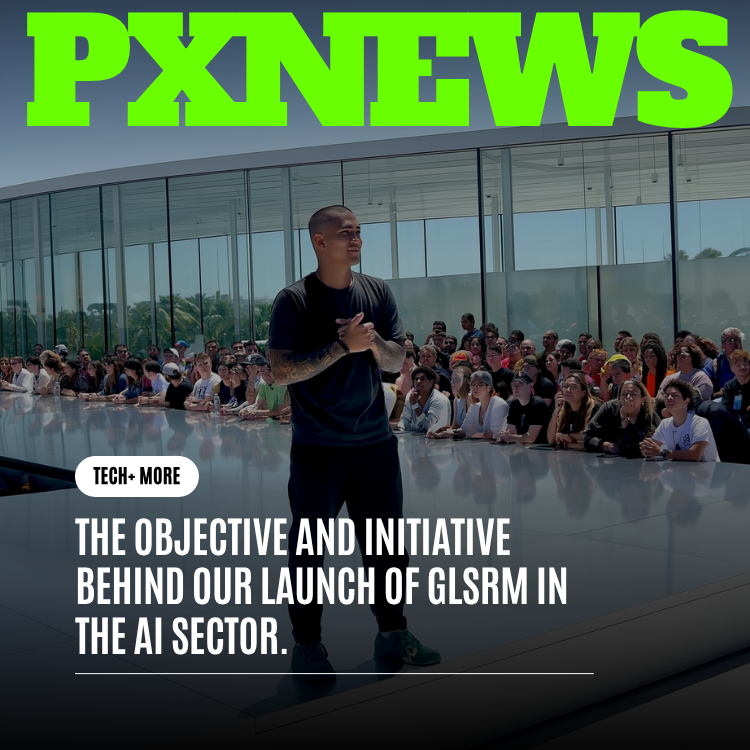
GLSRM didn't start as a product idea. It started as a complaint we kept having internally: the AI industry moves faster than any single feed, leaderboard, or newsletter can responsibly cover, and yet that's exactly how most of the world tries to follow it. This is the story of the objective behind GLSRM and the initiative inside ETAPX that turned a shared frustration into the front page of AI — why we believed this gap was worth closing, how it fits into our broader strategy, and what we think success looks like from here.
Every company has an origin moment that's less a strategy memo and more a recurring conversation. Ours was simple and kept repeating: someone on the team would mention a model release, and someone else would say they hadn't heard about it, and a third person would have heard about it from a completely different source with a completely different framing. We were a company built around AI-adjacent products, and even we couldn't agree on what had happened in the industry in the last 48 hours without comparing notes. If that was true for us, it was almost certainly true for everyone trying to keep up from the outside.
The Strategic Objective: Fragmentation Has a Cost
The starting observation behind GLSRM is not really about AI at all — it's about what happens to any fast-moving industry before it gets a dedicated, trustworthy press. Finance has Bloomberg terminals and a century of financial journalism. Sports has entire networks built around standings, scores, and analysis available in real time. Mainstream tech has a mature press corps that's been covering product launches and company moves for decades. AI, despite being arguably the most consequential and fastest-moving industry of the current moment, has none of that infrastructure at the same level of maturity. What it has instead is a sprawl: lab blogs, scattered changelogs, leaderboards that don't agree with each other, X threads, paywalled newsletters, and Discord servers, each holding a fragment of the picture and none of them holding the whole thing.
That fragmentation is not a minor inconvenience. It has a real, compounding cost. Every hour a researcher, founder, or builder spends reconstructing "what happened this week in AI" from a dozen sources is an hour not spent doing the work only they can do. Worse, fragmented information produces fragmented understanding — two people on the same team can walk away from "keeping up" with completely different pictures of the field, because they each assembled their own version from a different subset of sources. We watched this happen internally often enough to recognize it as a structural problem, not a personal failing of any one person's information diet.
The objective we set was specific: build the dedicated, editorially serious coverage layer that the AI industry has earned but doesn't yet have, and do it at the speed the industry actually moves, not the speed a weekly newsletter or a quarterly report can manage. Not another aggregator competing for the same fragmented attention. A front page — the place a serious person checks first, the way they'd check a market open or a sports score, except for the thing that's actually reshaping every other industry around it.
"We weren't trying to build a media company because we thought media was a good business. We were trying to solve our own problem first — we couldn't keep up with our own industry using the tools that existed — and we built the thing we wished already existed. GLSRM is that thing."
— Tomasz Reyes-Lindholm, VP of Strategy at ETAPX
The Initiative Inside ETAPX
Turning that objective into GLSRM required more than agreeing the gap was real. It required a deliberate internal initiative, because the instinct inside most companies, including ours at first, is to stay in your lane. ETAPX builds Whistlr. Why would a creator-focused social platform build a news and intelligence product for the AI industry?
The honest answer is that the initiative behind GLSRM came from a belief that runs deeper than any one product: that the way people organize their attention is shifting, and that AI is becoming infrastructure for everything else we build, not a side interest. The team building Whistlr's AI video editor needed to track model and tooling developments closely. The team thinking about Ocsidian's agentic game creation needed to understand the state of agentic systems in granular, current detail. We were already, functionally, doing the work of an internal AI intelligence desk just to build our own roadmap responsibly. The initiative was the recognition that the thing we'd built for ourselves out of necessity was good enough, and needed enough, to exist as its own product.
That's a different kind of initiative than "let's expand into media." It's closer to "we already built the muscle, the muscle is valuable, let's not waste it." Internally, that meant pulling together a small cross-functional group, not a brand-new media division, with a mandate to formalize the informal process we already relied on: tracking releases, scoring models against each other honestly, watching the research that would matter in six months instead of six days, and doing it on a cadence tight enough to be useful rather than retrospective. GLSRM is the output of that mandate, but the initiative itself was really a decision about what kind of company we wanted to be — one that treats understanding the AI landscape as core infrastructure, not a nice-to-have.
AI Deserves the Coverage Other Industries Already Have
Part of what drove this initiative is a belief we hold plainly: AI deserves the same quality of dedicated coverage that finance, sports, and mainstream tech have had for decades, and it doesn't have it yet because the industry is too young and moving too fast for that infrastructure to have caught up organically. Bloomberg wasn't built in a year. ESPN wasn't built in a year. Those institutions accreted slowly, alongside industries that, relative to AI, were almost leisurely in their pace of change.
AI doesn't have decades to wait for its version of that infrastructure to emerge organically, because the decisions being shaped by AI coverage today — what a founder builds, what a researcher prioritizes, what a builder deploys — are happening now, this quarter, this week. A field this consequential, moving this quickly, without a trustworthy editorial home, leaves a vacuum that gets filled by exactly the wrong incentives: engagement-optimized hot takes, overclaimed benchmark screenshots, hype cycles that move faster than the substance underneath them. We think that's a bad outcome not just for the people trying to follow AI, but for the industry's own credibility. An industry that can't accurately report on itself has a harder time being trusted by everyone watching it from outside.
So the belief behind GLSRM isn't "AI needs more content." It's "AI needs the same editorial seriousness that older, slower industries already take for granted" — curated rather than exhaustive, data-grounded rather than vibes-based, and fast enough to matter. That's a higher bar than most AI coverage sets for itself today, and clearing it was the entire design brief.
"Nobody questions why finance has dedicated, serious, real-time coverage. Nobody questions why sports does. The only reason AI doesn't yet is that the industry is younger than the infrastructure it deserves. We didn't want to wait for someone else to build it on AI's behalf."
— Tomasz Reyes-Lindholm, VP of Strategy at ETAPX
How GLSRM Fits the One-Account Ecosystem Strategy
None of this happened in isolation from the rest of what ETAPX builds, and that's deliberate. Our broader strategy has never been to build a portfolio of disconnected apps that happen to share a logo. It's to build a small number of genuinely excellent, focused products — Whistlr for friend-first social and creator monetization, Ocsidian for agentic game creation, and now GLSRM for AI intelligence — that are each complete on their own but stronger because they share one account and one identity.
That matters more for GLSRM than it might first appear. A reader who comes to GLSRM purely to check the Wire or scan Data Pulse gets a complete experience without ever touching anything else we build. But the moment they want to talk about what they just read, Circuits is right there, and the account they use to post in a SubCircuit is the same account that carries across the rest of the Whistlr ecosystem. That's not a growth hack bolted onto a content product. It's the same philosophy that shapes everything else at ETAPX: independence without isolation. Every product should be whole by itself and meaningfully better in company.
There's a strategic logic underneath that philosophy too. The people who care enough about AI to use GLSRM daily are disproportionately likely to be builders, creators, and founders — exactly the audience already building things with Whistlr's creator tools or experimenting with Ocsidian's agentic systems. A one-account ecosystem means we're not just building three products for three audiences; we're building one connected audience that moves between products as their needs shift, without ever having to re-establish who they are. GLSRM earns its place in that ecosystem by being excellent at its own job first. The ecosystem effects are the compounding return on top, not the reason it exists.
What Success Looks Like for This Initiative
We're specific internally about what we're actually trying to achieve with GLSRM, because "be the front page of AI" is a vision statement, not a success metric. A few concrete signals matter more than vanity numbers as this initiative matures.
The first is becoming a default, not a destination. Success isn't measured by people remembering to check GLSRM occasionally; it's measured by GLSRM becoming the place someone opens reflexively, the way a trader opens a terminal or a fan checks a score, before they think to look anywhere else. That's a behavioral bar, not a traffic bar.
The second is trust that compounds rather than erodes. An editorial product survives on the accumulated belief that what it tells you is accurate and what it links to is real. Every story that holds up, every benchmark claim that Data Pulse and Benchmarks let a reader verify instead of just trust, every source linked rather than hidden, adds to that account. We're tracking trust qualitatively as much as quantitatively, because it's the asset that's hardest to rebuild once spent.
The third is the health of Circuits as an actual community, not just a feature. A community layer succeeds when SubCircuits become places people return to because the conversation is genuinely good, not because we drove a one-time spike of registrations. Threaded discussion quality, moderator engagement, and SubCircuits that sustain themselves organically are the real markers here, more than raw account counts.
The fourth is ecosystem pull-through measured honestly. We expect some meaningful share of GLSRM's community to engage with the rest of the Whistlr ecosystem over time, not because we funnel them there artificially, but because a single account naturally invites it. We're watching that number, but we're not going to chase it at the expense of GLSRM being excellent as a standalone product first.
And the last, maybe the most important: the initiative succeeds if, a few years from now, "check GLSRM" is as unremarkable and obvious a habit for someone serious about AI as "check the market" is for someone in finance. That's a long horizon for a young product, and we're comfortable with that. Infrastructure that matters is rarely built quickly, and we'd rather build the version of GLSRM that's still the right answer in five years than the version that's fastest to a headline this quarter.
"I used to have eleven tabs open just to start my morning — three leaderboards, a couple of lab blogs, a newsletter I was always behind on. Now I open GLSRM first and decide from there what's actually worth digging into. That's the whole value proposition for me, and it's exactly the problem I'd have expected a company outside the media world to get wrong, but they didn't."
— Inez Calloway, GLSRM reader and independent ML researcher
Frequently Asked Questions
Why did ETAPX, a social media and gaming company, build an AI news platform?
ETAPX was already doing the work of tracking AI developments closely to build products like Whistlr's AI video editor and Ocsidian's agentic game creation tools. GLSRM formalizes an internal capability we relied on out of necessity into a standalone product, built on the belief that AI deserves the same dedicated, serious coverage that industries like finance and sports already have.
What problem is GLSRM actually trying to solve?
GLSRM addresses the fragmentation of AI industry coverage. Right now, following AI seriously means piecing together changelogs, leaderboards, newsletters, and Discord servers, and that fragmentation has a real cost: wasted time, inconsistent understanding, and a vacuum that gets filled by hype-driven content instead of editorially serious coverage.
How does GLSRM relate to ETAPX's other products like Whistlr and Ocsidian?
GLSRM is part of ETAPX's one-account ecosystem strategy. Each product, including Whistlr, Ocsidian, and GLSRM, is designed to be complete and valuable on its own, but they share a single account and identity so the community on one product can naturally connect with the others without re-registering or fragmenting their identity.
Is GLSRM meant to compete with existing AI newsletters and leaderboards?
Not directly. GLSRM's objective isn't to win an attention competition with any single newsletter or leaderboard, but to provide the connective, editorial layer that ties scattered sources together into one trustworthy, continuously updated front page, while still linking outward to original sources rather than replacing them.
What does ETAPX consider success for the GLSRM initiative?
Success is GLSRM becoming a default habit for people serious about AI, not just an occasional destination, paired with compounding trust in its accuracy and sourcing, a genuinely active Circuits community, and meaningful (but not forced) crossover into the wider Whistlr ecosystem over time.
How is this initiative different from ETAPX just expanding into media?
The initiative didn't start with a decision to enter the media business. It started with ETAPX already doing AI-tracking work internally to support its own roadmap, and recognizing that the same discipline, applied publicly and rigorously, was valuable enough to stand on its own as the front page of AI.
GLSRM is still early in a long initiative, and the objective hasn't changed since the first internal conversation that started it: give the AI industry the dedicated, trustworthy coverage it has earned but hasn't had. If you're trying to keep up with AI and tired of reconstructing the picture yourself from a dozen sources, that's exactly the gap GLSRM was built to close.