
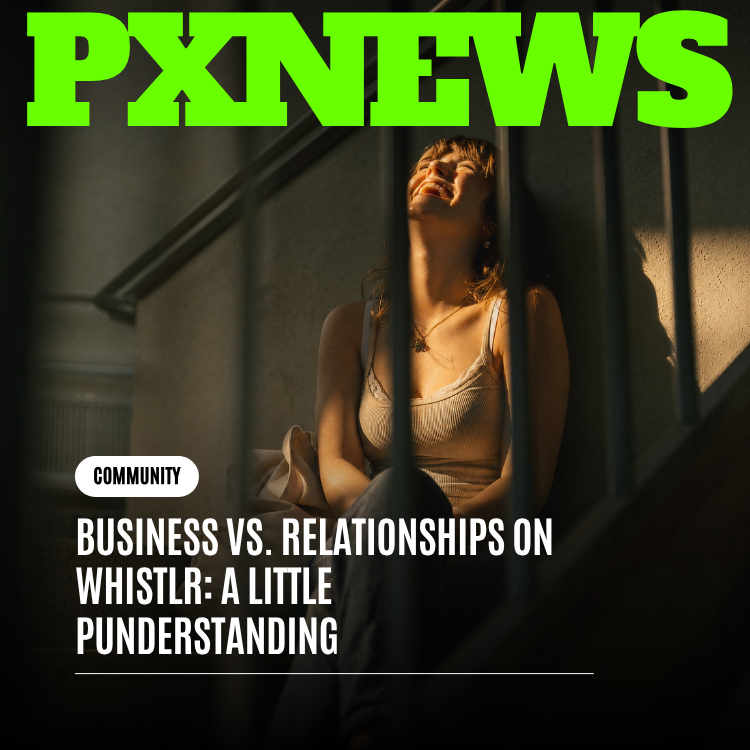
There's a comfortable myth floating around that a platform can be good at business or good at relationships, but not really both — that the moment money enters the picture, something in the relationship gets a little less real. On Whistlr, that assumption doesn't survive contact with how Gems, creator monetization, and the business partner platform actually work. Call it a punderstanding: a genuine misunderstanding wearing a pun as a disguise, and it's worth taking apart properly.
The Punderstanding, Defined
Here's the assumption, stated plainly instead of implied: running a business and building a genuine relationship are opposing forces, so the more a platform monetizes something, the less authentic that something becomes. It's an old assumption, and it didn't come from nowhere. A decade of ad-supported social media taught people, correctly, to be suspicious of "monetization" as a word — it usually meant their attention was the product, their data was the inventory, and the platform's actual customer was somebody else entirely. Influencer marketing taught a similar lesson from a different angle: the moment a post is sponsored, audiences instinctively downgrade how much they trust it, because sponsorship has often meant a relationship got rented out to the highest bidder for a day.
Both of those lessons are reasonable responses to real, well-documented bad behavior elsewhere. They're just not universal laws, and treating them as though they apply everywhere — including to Whistlr — is exactly the punderstanding this piece is named for. Whistlr's monetization tools weren't built by asking "how do we extract value from these relationships." They were built by asking "how do we let people signal something real to each other, and let a business model follow from that, instead of the other way around." That's a small distinction on paper and an enormous one in practice, and it's the whole reason this particular punderstanding doesn't hold up here.
The Flip Side of a Coin We've Already Flipped
We've written before about why investing in real community relationships — building an actual Discord in Campus instead of just broadcasting announcements at people — is itself a business decision, not a values statement floating above one. That argument was about community investment: the case that a company willing to slow down and build trust with the people around it outperforms one optimizing purely for one-way reach.
This is the flip side of that same coin, and it's a genuinely different argument, not a rerun. That earlier piece was about whether a business should invest in relationships. This one is about something narrower and, in some ways, more provocative: whether the act of monetizing a relationship — putting a price, a Gem, or a contract next to it — necessarily degrades it. Community investment and creator monetization sit on the same coin because they're both ultimately about trust, but they're not the same question, and conflating them is how a lot of "business vs. relationships" takes go sideways before they even get started.
What a Gem Actually Says
Start with the smallest possible unit of "business" on Whistlr: a single Gem, sent from a viewer to a creator during a livestream. It's tempting to file that under "transaction" and move on — money changed hands, a service was rendered, end of story. But that framing misses what's actually happening in the moment a Gem gets sent, and the miss is the whole punderstanding in miniature.
A transaction replaces a relationship with a receipt. You pay for a coffee, you get a coffee, and the exchange is complete the second the cup changes hands — neither party owes the other anything else, and neither expects to. A Gem doesn't behave like that. A viewer sending a Gem isn't closing out an interaction, they're opening one — announcing, in front of a room full of other people, that a specific moment from a specific creator was worth something to them. The creator sees it land in real time, often reacts to it live, and the moment becomes a small shared beat between two people instead of a completed sale. Nobody's relationship with their barista deepens because they paid for a latte. Plenty of creator-supporter relationships on Whistlr deepen specifically because a Gem was sent, seen, and acknowledged.
That's the mechanical reason a Gem functions as a relationship signal instead of a relationship substitute: it doesn't close a loop, it opens one. The supporter is telling the creator something about what they value. The creator's response — a shoutout, a shared goal reached together, a running joke that exists because of who's shown up consistently — is the platform's monetization tool doing the opposite of what the punderstanding predicts. It isn't standing in for connection. It's generating it.
"I used to think the money side of streaming would feel weird, like I was asking people to pay for my friendship. It's the opposite. My regulars send Gems and I know their names, I know their jokes, I know when one of them is having a rough week because they show up quieter than usual. The Gems didn't create that closeness, but they gave it somewhere to land."
— Briana Solheim, Whistlr creator
None of this requires supporters to be saints or creators to be selfless. People send Gems partly because it feels good to be seen doing it, and creators appreciate the income, obviously. The point isn't that money is irrelevant to the exchange. It's that the specific shape of this exchange — public, immediate, tied to a real moment between two real accounts — routes the money through the relationship instead of around it.
Trust Is the Business Model
Zoom out from a single Gem to the business partner platform connecting brands and creators, and the same logic shows up at a completely different scale. Traditional ad infrastructure — the kind that's powered most of the internet's advertising for two decades — runs on impressions. An advertiser buys a number: eyeballs, clicks, views, delivered by an algorithm to an audience it usually can't describe with much more precision than a demographic bracket. Nobody involved in that exchange necessarily knows or trusts anybody else. The audience is inventory. The relationship, if you can even call it that, is incidental to the transaction.
The business partner platform is built to work the opposite way, and it has to, because what's actually being evaluated isn't reach — it's fit. A brand isn't buying a quantity of impressions from a faceless inventory pool. It's assessing an actual creator: their history, their audience, their track record on past partnerships, whether their content and their following genuinely overlap with what the brand needs. That evaluation only works if both sides can trust what they're looking at, which is why the platform leans on verification, visible history, and structured terms instead of an anonymized auction. Strip the trust layer out and there's no product left underneath it — just a directory nobody can rely on.
This is the part of the punderstanding that's easiest to miss: people assume "business platform" means the relationship-y part gets stripped out to make room for the commerce, when on Whistlr the relationship-y part — verification, reputation, track record — is the mechanism that makes the commerce possible at all. A brand doesn't choose a creator despite the trust-building infrastructure. It chooses a creator because of it.
"Ad impressions are a commodity — you can buy the same views from any number of vendors and none of them care which one you picked. A creator relationship isn't a commodity. It has a history, a reputation, a reason a specific brand fits a specific audience and not another one. We didn't build a business platform next to the trust layer. The trust layer is the business platform."
— Femi Adeyemi, VP of Monetization at ETAPX
That's why repeat collaboration is the platform's actual success metric, not a pleasant side effect. A brand and creator who complete one milestone-based campaign well are positioned to run a second one without re-litigating basic trust from scratch — the same dynamic that makes any human relationship easier the second time around, just formalized into product infrastructure instead of left to chance.
Where Monetization Really Does Build Distance
None of this works as an argument if it pretends the opposite case never happens, so it's worth being honest about when the "business vs. relationships" framing is actually correct. Monetization does create distance, constantly, across plenty of platforms and plenty of business models. An algorithmic feed that optimizes for watch time over connection will, predictably, serve people content designed to hijack attention rather than content their actual friends posted. A creator pressured into shilling a product their audience can tell they don't believe in trades a sliver of trust for a check, and audiences remember it longer than the creator would like. A payout structure with a delayed, opaque cut breeds the entirely reasonable suspicion that the platform is quietly the one being served, not the creator or the supporter.
Those aren't hypothetical failure modes — they're the well-earned reasons the original assumption exists in the first place. Anyone who's watched a favorite creator get noticeably weirder after a big sponsorship deal, or noticed a feed getting worse the more "personalized" it claims to become, has direct evidence that money and authenticity can absolutely pull apart. The punderstanding isn't that this never happens. The punderstanding is treating it as an iron law instead of a design failure — assuming distance is simply what monetization does, instead of what bad monetization does.
That distinction matters enormously, because it means the fix isn't refusing to monetize. It's monetizing in a way that doesn't create the incentive to hijack attention, misrepresent a partnership, or hide the split. Gems and the business partner platform are specific, deliberate answers to that design problem, not proof that the problem doesn't exist elsewhere.
The Design Choices That Keep Both Sides of the Pun on the Same Team
Put the failure modes from the previous section next to Whistlr's actual monetization design and the contrast is specific enough to check line by line, rather than take on faith.
- Transparent splits instead of opaque cuts: Creators can see exactly what a Gem is worth to them, tracked in real time through the Creator Studio Dashboard, instead of discovering a smaller number after a delayed payout. Suspicion about a hidden cut is one of the fastest ways monetization curdles a relationship, and transparency removes the question before it gets asked.
- Real-time acknowledgment instead of a delayed statement: A Gem lands, and the creator can respond to it in the same minute, in front of the same audience. Distance grows in the gap between an action and its acknowledgment — collapse that gap and the exchange stays personal instead of turning into a line item on a monthly summary.
- Milestone partnerships instead of impression auctions: The business partner platform is structured around campaigns with defined deliverables and a visible record of what was agreed, built to lead into a second and third collaboration, rather than a one-off placement priced by reach alone.
- Verification as a trust signal, not a gate: Knowing who's actually behind an account lets brands and creators skip the overhead of proving good faith every single time, which is the overhead that makes purely transactional relationships exhausting to maintain in the first place.
Every one of those choices is a small refusal to let the business side of the equation operate in the dark, and darkness is where the distance in "monetization creates distance" actually comes from. Take away the transparency, the immediacy, the repeat structure, and the verification, and you'd get a platform where the punderstanding stopped being a punderstanding and just became an accurate description. The design is the reason it doesn't.
Business and Relationship Were Never Opposite Ends of a Spectrum
Line the two halves of the title up next to each other and the honest conclusion is that they were never actually competing for the same space. A Gem is simultaneously a revenue event and a relationship event, and asking which one it "really" is misunderstands the mechanism — it's both, at the same time, because the design routes them through the same action instead of trading one for the other. The business partner platform is simultaneously a commerce tool and a trust-verification system, and the second half is what makes the first half work, not what gets sacrificed for it.
So the actual resolution to the punderstanding isn't "business matters more than relationships" or the reverse. It's that on Whistlr, they were never really two separate things being weighed against each other — they're the same mechanism, described from two different angles, and the argument only looked like a fight because the framing assumed a competition the product was never actually running. Once you see that, the pun does the rest of the work: this was never much of a business-vs-relationships story so much as a punderstanding about whether one was ever fighting the other. It wasn't. Case closed, pun very much intended.
Frequently Asked Questions
Isn't charging for anything a step toward making it feel more transactional?
Not automatically — it depends entirely on what the charge is attached to. A transaction closes a loop: value for value, exchange complete, nothing else expected. A Gem opens one: it's a visible, real-time signal from one specific person to another that gets acknowledged rather than filed away. The presence of money isn't what determines whether an exchange feels transactional. What the money is tied to determines that.
How is sending a Gem different from paying for a subscription or an ad-free tier?
A subscription or an ad-removal fee is a transaction with a platform — you pay, a feature toggles, and the exchange has nothing to do with any specific person. A Gem is a transaction with a person, sent during a specific moment, visible to that person and often to a community around them. The difference isn't the presence of a price tag, it's who the payment is actually between.
Why does trust matter more than reach on the business partner platform?
Because reach is a number almost anyone can buy, and a number doesn't tell a brand whether a creator's audience is the right audience. Trust — built through verification, visible history, and a track record of completed partnerships — is what tells a brand a creator relationship is worth building rather than just a placement worth renting for a week. Reach fills a quota. Trust is what makes a second campaign worth running.
Doesn't this article just repeat what ETAPX already said about business relationships mattering?
No, and the distinction matters. That earlier piece argued that investing in community — building a real Discord in Campus instead of just broadcasting into one — is itself a smart business decision. This piece argues something narrower: that monetizing a relationship on Whistlr, through Gems or the business partner platform, doesn't have to commodify it. Same coin, different face.
Can monetization ever damage a creator-supporter relationship on Whistlr?
Yes, in the same way any business practice can go wrong if it's designed carelessly. What keeps that from being the default outcome is specific: transparent splits, real-time acknowledgment, and partnership structures built around repeat collaboration rather than one-off extraction. Remove those design choices and the risk described in this article would be real. They're the reason it mostly isn't.
What's the actual takeaway for a creator or brand deciding how much to lean into monetization?
That leaning into monetization on Whistlr isn't automatically a trade against the relationship side of the business. Done through Gems or the business partner platform, it's frequently the thing that deepens the relationship, because it gives supporters and partners a concrete way to signal what they value. The caution isn't "monetize less." It's "monetize in a way that keeps the exchange visible, immediate, and tied to a real person" — which is exactly what these tools are built to do.
The punderstanding was never really about Whistlr specifically — it's a hangover from a decade of platforms that made "monetized" and "genuine" into opposites through their own bad design, and it's a fair scar to carry around. But a scar isn't a law of nature, and Gems, creator monetization, and the business partner platform are the evidence: build the exchange around transparency, immediacy, and real accounts instead of anonymized volume, and the business side stops competing with the relationship side for the same seat at the table. They were always sitting in the same chair. The only misunderstanding was assuming there were two.