
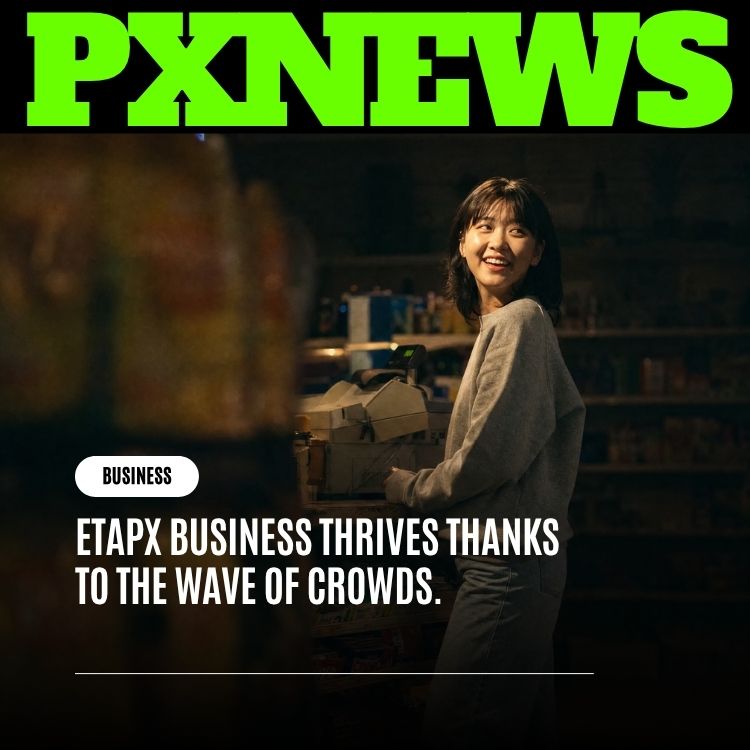
Most companies can point to the campaign, the ad spend, or the launch-day stunt that moved their growth chart. ETAPX's chart tells a different story. Look closely at how Whistlr's Circuits fill up, how a Wave playlist ends up shared across three different group chats by the weekend, or how a single creator's Collab invite turns into a dozen new faces inside a SubCircuit, and you find the same engine running underneath almost every gain: word of mouth, moving through real social circles, at the pace real trust actually travels. This is the story of how ETAPX built a business that thrives on that wave of the crowd, why crowd-driven growth tends to outlast anything a marketing budget can manufacture, and what the company actually does — quietly, on purpose — to keep earning it.
Growth That Was Never Bought, Only Earned
Ask most growth teams in tech how their user base got this big, and you'll hear about media budgets, influencer retainers, and a launch calendar planned months in advance. None of that is inherently wrong — plenty of good companies use paid acquisition well. But it tends to produce a specific kind of growth: rented, not owned. Turn off the spend and the curve flattens almost immediately, because the people who arrived were responding to a budget line, not to anything they'd actually experienced yet.
ETAPX has never really been able to point to that kind of chart, and at this point, the company has mostly stopped wanting to. What has actually moved the needle, quarter after quarter, looks far less controllable and far more durable: someone already on Whistlr telling a friend to come check out their SubCircuit, a Circuit built around a shared interest getting recommended in a completely unrelated group chat, a Creator Studio success story circulating among other creators who'd been skeptical about switching platforms at all. None of it was engineered from a dashboard. All of it came from people who'd already gotten something real out of being there, and simply wanted the people they actually knew to have it too.
Spend a week around ETAPX's Bay Area headquarters and you'll notice this shows up in how the team talks about growth internally, too. Nobody leads with impressions or click-through rates. They lead with which Circuits are pulling in new members without any prompting, which creators are bringing collaborators over from other platforms entirely unasked, which features are showing up organically in screenshots and shares nobody paid for. That's the scoreboard that actually matters here, and it's a different scoreboard than most companies keep.
What Word of Mouth Actually Looks Like Inside Whistlr
"Word of mouth" can sound like a vague, almost old-fashioned phrase next to terms like growth loops or acquisition funnels, but on Whistlr it's a concrete, observable pattern with a handful of recognizable shapes. It rarely looks like one dramatic moment. It looks like a lot of small, ordinary handoffs, repeated often enough that they add up to something that resembles a wave far more than a single splash.
From One Circuit to a Dozen Friends
The most common shape starts small: one person finds a Circuit or SubCircuit that fits something they actually care about, sticks around because the conversation is genuinely good, and eventually invites two or three people from their existing friend group who'd enjoy the same thing. Those two or three, in turn, tend to do the same. Nobody involved in that chain was targeted by an ad. They were extended an invitation by someone whose taste they already trusted, which is a fundamentally different kind of persuasion than anything a campaign can buy.
- Creator-to-creator referrals: A creator who's had a genuinely good experience with Creator Studio or Gems tells other creators directly, often the exact people least inclined to trust a platform's own marketing.
- Communities recommending Circuits to friends: An active SubCircuit doesn't just retain its own members — it becomes something those members bring up unprompted, in conversations happening entirely off the platform.
- Whole social circles arriving together: Group chats and existing friend groups tend to migrate in clusters rather than one person at a time, because the value of being where your people already are compounds fast once a few of them have made the move.
- Collaboration pulling in new audiences: A Collab between two creators doesn't just combine two pieces of content — it introduces each creator's audience to the other, organically, as a natural byproduct of the collaboration itself.
What ties all four together is that none of them required ETAPX to intervene. They required the product to be good enough, and the community around it healthy enough, that people wanted to extend the invitation themselves.
Why Crowd-Driven Growth Outlasts Manufactured Virality
It's worth being precise about what "manufactured virality" actually means, because it's easy to confuse with genuine word of mouth when you're only looking at a growth chart from a distance. A manufactured spike usually comes from something engineered to travel fast on its own terms: a stunt, a manufactured controversy, a trend format built specifically to be copied by as many accounts as possible. It can produce a large number quickly. What it rarely produces is a reason for the people who showed up to stick around once the moment that brought them has passed.
The Difference Between a Spike and a Wave
A spike is loud and brief. It arrives all at once, driven by novelty, and it recedes just as fast once the novelty wears off or gets replaced by whatever trend format comes next. A wave behaves differently. It builds more slowly, because it's carried by individual decisions — one person deciding a specific friend would genuinely like this — rather than by a single moment everyone happens to react to at once. But a wave also doesn't recede the same way, because each of those individual decisions arrived with a reason attached. The friend who joined a Circuit because someone they trust recommended it isn't leaving the moment some trend cycles out, because the trend was never why they came in the first place.
This is also why crowd-driven growth tends to compound in a way manufactured virality structurally can't. Someone who arrives because of a friend's recommendation tends to become the next referral point themselves, once they've had their own good experience worth talking about. Someone who arrives because of a viral stunt usually has no obvious next person to tell, because the stunt was never really about them — it was about the moment. One of those patterns builds on itself, quietly, month after month. The other has to be reignited from scratch every single time.
None of this means ETAPX ignores big, attention-grabbing moments entirely — a strong launch or a well-produced piece of content can still widen the top of the funnel in a useful way. But the company has learned not to mistake that initial attention for the actual engine underneath it. The attention gets people to look. The wave of the crowd is what actually gets them to stay, and then to bring somebody else along behind them.
Earning the Wave of the Crowd: How ETAPX Treats the People Who Carry It
None of this happens automatically just because a product exists. A crowd doesn't carry a business forward out of obligation, and it stops the moment it feels used rather than respected. ETAPX's position internally is that crowd-driven growth has to be earned continuously, not won once and coasted on afterward, and that shows up in a handful of concrete choices about how the company treats the people actually doing the carrying.
- Treating creators as partners, not inventory: Gems and Creator Studio were built around the idea that a creator's success and the platform's success should move in the same direction — a creator who feels fairly treated is a creator willing to vouch for the platform publicly, unprompted.
- Building features designed to be shared, not gamed: Collab, group chats, and Circuits were designed around genuine collaboration and community, which happens to make them naturally shareable — a very different design goal from engineering a feature purely to maximize forwards and shares.
- Keeping the door low-friction: Joining a friend's Circuit or jumping into a group chat someone invited you to should feel like walking through an open door, not filling out a form — friction at the exact moment of invitation is where word of mouth quietly dies.
- Actually listening when the crowd says something: When a community consistently asks for something, or organizes itself around a workaround, that gets treated as a genuine signal worth responding to, not noise to route around.
Renata Solis, who leads growth at ETAPX, put it plainly when asked why her team doesn't spend more of its energy on traditional acquisition channels.
"We could absolutely go buy a bigger number next quarter. What we can't buy is a creator telling another creator, unprompted, that this is a place worth their time. That single recommendation is worth more to us than most of what a media budget can produce, and it only happens if we've actually earned it — so a huge amount of what my team does isn't acquisition at all. It's making sure the product keeps giving people a genuine reason to say something good about it."
— Renata Solis, VP of Growth at ETAPX
That framing matters because it changes what the growth team is actually optimizing for on a day-to-day basis. Instead of asking how to get in front of more people, the operating question becomes how to make sure the people already here have a genuinely good reason to bring someone else along with them.
Collab and Group Chats: Two Features Built to Multiply
Two features on Whistlr illustrate this philosophy better than anything ETAPX could say about it directly, because you can watch the crowd-driven effect happen in something close to real time inside each one.
Collab lets two creators build something together instead of separately, and the growth effect is almost a side effect of good design rather than the actual point of it. When two creators collaborate, each one's existing audience gets a natural, low-pressure introduction to the other — not through a paid placement or a forced cross-post, but through a piece of content both audiences already wanted to see in the first place. The creators get a better collaboration. Each of their communities gets introduced to someone new they might genuinely like. ETAPX gets a small, organic wave of new attention that nobody had to buy.
Group Chats as an Onramp for Whole Social Circles
Group chats do something similar at the level of ordinary friendships rather than creator audiences. A single person joining Whistlr on their own has to build an experience from nothing. A person whose entire friend group moves over together, dragging an existing group chat along with them, arrives with the whole context already intact — inside jokes, shared interests, an established reason to keep coming back that has nothing to do with the platform itself and everything to do with each other. That's a fundamentally stickier kind of arrival than any single onboarding flow could ever produce, and it happens because the people already here decided it was worth bringing their circle along too.
"I didn't move my whole friend group onto Whistlr because anyone asked me to. We had a group chat that had been dying a slow death on another app for years, and someone finally said 'just come argue about music over here instead.' Six of us made the jump within a week. Then a Collab I did with another musician introduced me to a completely different crowd I never would have found on my own. Neither of those things happened because of an ad. They happened because the stuff we were already doing together felt like it belonged somewhere better."
— Idris Kagwe, independent musician and Whistlr creator
Multiply that pattern across enough Circuits, enough Collabs, and enough group chats, and you start to see why ETAPX talks about this as a wave rather than a series of individual wins. No single one of these moments moves a chart very much on its own. All of them happening constantly, in parallel, across thousands of small social circles, is a genuinely different thing entirely.
Riding a Wave Is Different From Riding a Trend
It's tempting to lump all organic-feeling growth together under one label, but riding a wave of real people and riding a trend are not the same thing, and confusing the two is one of the more common mistakes a growing company can make. A trend is external. It belongs to the internet at large, it has a shelf life measured in weeks, and a company riding one is ultimately borrowing momentum it doesn't own and can't control once it ends. A wave of the crowd is different because it belongs to the company's own community — it's made of people who have a relationship with the product and with each other, not with a passing format.
That distinction is why ETAPX treats crowd-driven growth as a genuine long-term asset rather than a marketing tactic to rotate in and out. A trend-chasing company has to find the next trend the moment the current one fades, over and over, indefinitely. A company carried by its own community's word of mouth is instead building something that compounds: every creator treated well, every Circuit that stays genuinely good, every Collab that introduces two audiences to each other, adds another small current to a wave that keeps building rather than one that has to be rebuilt from nothing every quarter.
It's also, frankly, a better bet for where ETAPX wants to be years from now, not just this quarter. Whistlr is the clearest example because it's the product where the wave is most visible today, but the same instinct — earn the recommendation, don't manufacture the spike — is the standard the company is trying to hold itself to as GLSRM, Ocsidian, and Influxx each grow into their own audiences as well. A person who already trusts ETAPX because a friend brought them onto Whistlr in good faith is a person predisposed to give the next thing the company builds a fair, generous look. That kind of trust doesn't show up on a weekly dashboard. It shows up over years, which is exactly the timescale a real business is supposed to be building for in the first place.
Frequently Asked Questions
What does ETAPX mean by "the wave of the crowd"?
It's the way ETAPX describes the pattern its growth actually follows: not a single viral spike or a manufactured marketing push, but a slow, compounding wave built from ordinary recommendations — a creator telling another creator, a friend inviting a friend into a Circuit, a group chat deciding to make the move together. No individual moment is especially dramatic. Enough of them happening at once is what actually moves the business forward.
How is crowd-driven growth different from paid acquisition?
Paid acquisition brings people in response to a budget line, and it tends to stop the moment the spend stops. Crowd-driven growth brings people in response to a recommendation from someone they already trust, which means it doesn't switch off when a campaign ends — it keeps compounding as long as the underlying product and community keep giving people a genuine reason to invite someone else.
Why does word of mouth matter more to ETAPX than viral moments?
A viral moment can widen attention quickly, but it rarely gives the people who show up a reason to stay once that moment passes. Word of mouth works differently because it always arrives with context attached — a friend, a creator, or a community someone already trusted told them this was worth their time — and that context is exactly what turns a first visit into someone who sticks around and eventually becomes a recommendation themselves.
What does ETAPX actually do to encourage this kind of growth?
Mostly, it focuses on earning it rather than engineering it: treating creators as genuine partners through things like Gems and Creator Studio, building features such as Collab and group chats that are naturally shareable because they're built around real collaboration and community, and keeping the friction low the moment someone wants to bring a friend in.
Does ETAPX use any paid marketing at all?
Yes — a well-produced launch or a strong piece of content can still widen the top of the funnel, and ETAPX doesn't pretend otherwise. But the company treats that kind of attention as a starting point rather than the engine itself, because the wave of the crowd, not the initial spike, is what has actually carried the business forward over time.
The chart still moves, quarter after quarter — it just isn't the chart most companies would recognize as a growth strategy. It's built one recommendation at a time, by creators, friend groups, and communities who decided ETAPX was worth vouching for themselves. That's a slower story to tell than a viral spike, but it's the one still standing a year later, and it's the wave ETAPX intends to keep earning, one honest recommendation at a time.